What is cryogenic deflashing for rubber parts?
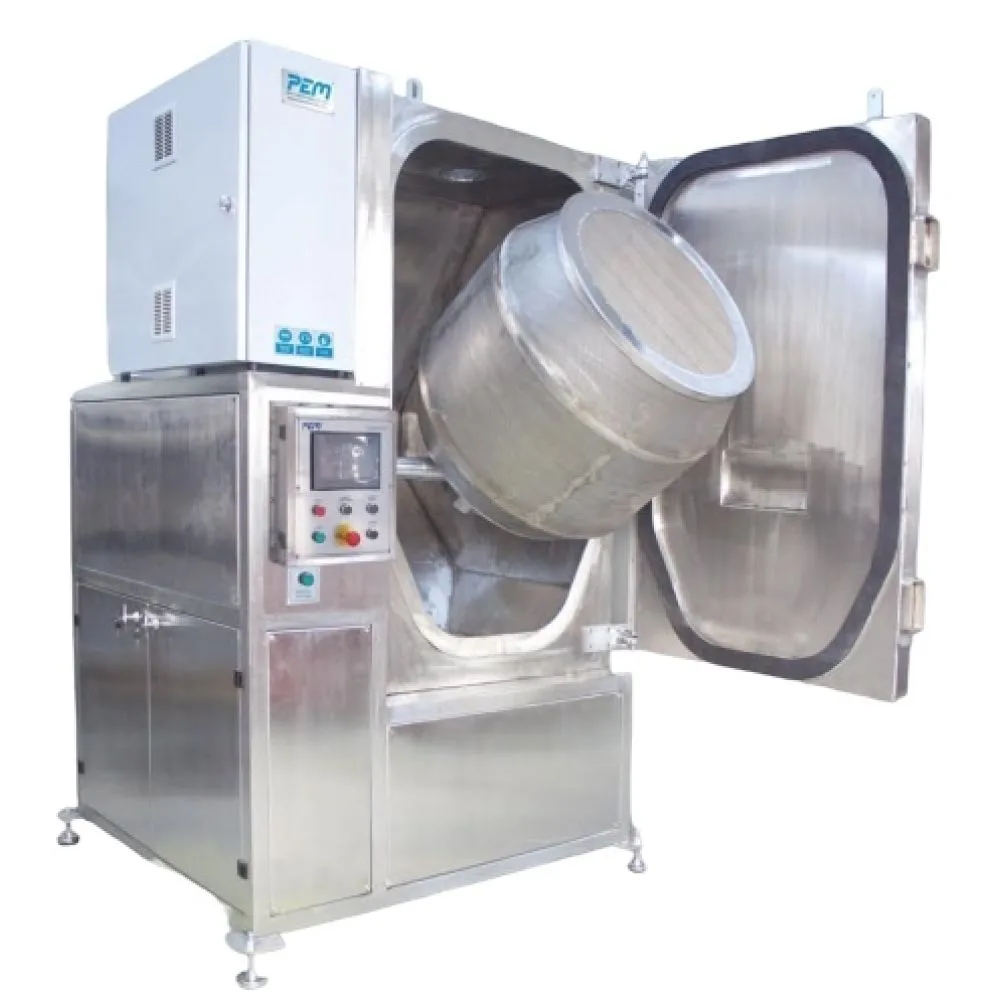
Cryogenic deflashing embrittles the thin flash on rubber and silicone parts with liquid nitrogen and breaks it off with media bombardment. This article explains the principle, why it beats mechanical methods, which parts suit it and how to reduce nitrogen consumption.
Almost every rubber part that leaves a mould carries a thin skin of excess material along its edges. This film, known as flash, forms along the parting line of the mould halves, in the vent channels and around pin cavities. Flash spoils the appearance of a part, and when it sits on a sealing surface it can compromise the very function the part was made for. For this reason, deflashing is as important a step in the production of rubber, silicone and other elastomer parts as the moulding itself.
Why flash forms
Whether the part is injection, transfer or compression moulded, a small amount of material escapes into the mould parting surfaces as the cavity fills. Mould wear, insufficient clamping force or a deliberately generous charge all increase the thickness of the flash. Because flash can never be eliminated entirely, a reliable post-moulding removal method is essential.
The limits of mechanical methods
Traditionally, flash is removed by hand, with knives, abrasives or tearing fixtures. These approaches work for small quantities but carry a few fundamental problems:
- Elastomers are flexible at room temperature; a blade tends to push the flash rather than cut it, and the part itself is frequently damaged.
- The work is labour-intensive and the result depends on the attention of the operator, so it varies from part to part.
- On complex geometries, internal channels or very small parts, there are areas that no blade can reach.
The principle of cryogenic deflashing
Cryogenic deflashing relies on the way elastomers change behaviour at low temperature. Every rubber and silicone compound has a glass transition temperature; below that point the material stiffens and becomes brittle. Because flash is far thinner than the body of the part, it cools much faster and turns brittle first. A machine that exploits this difference can break off the flash while the body of the part remains flexible.
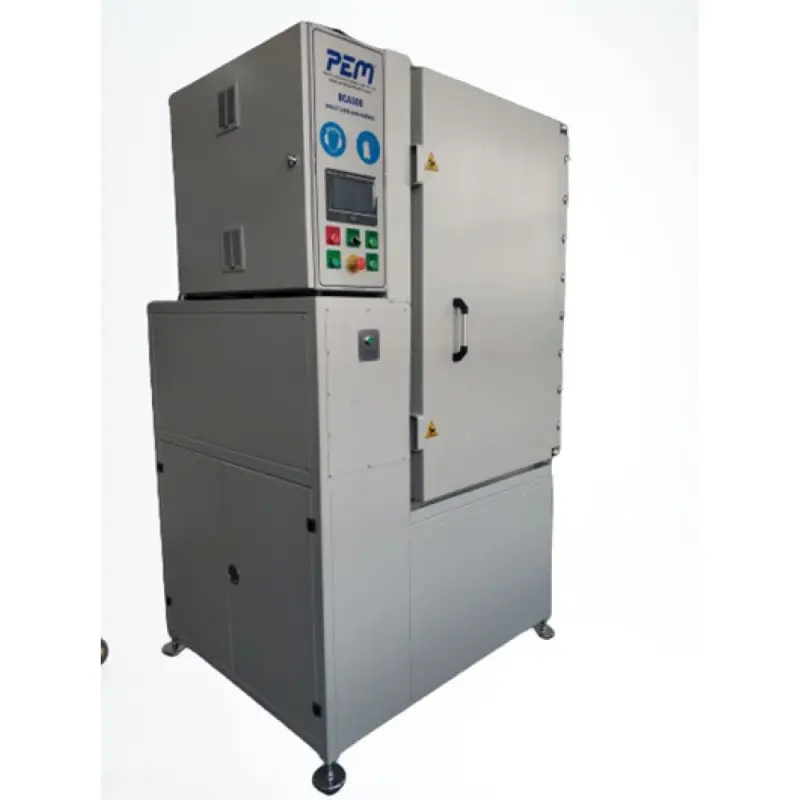
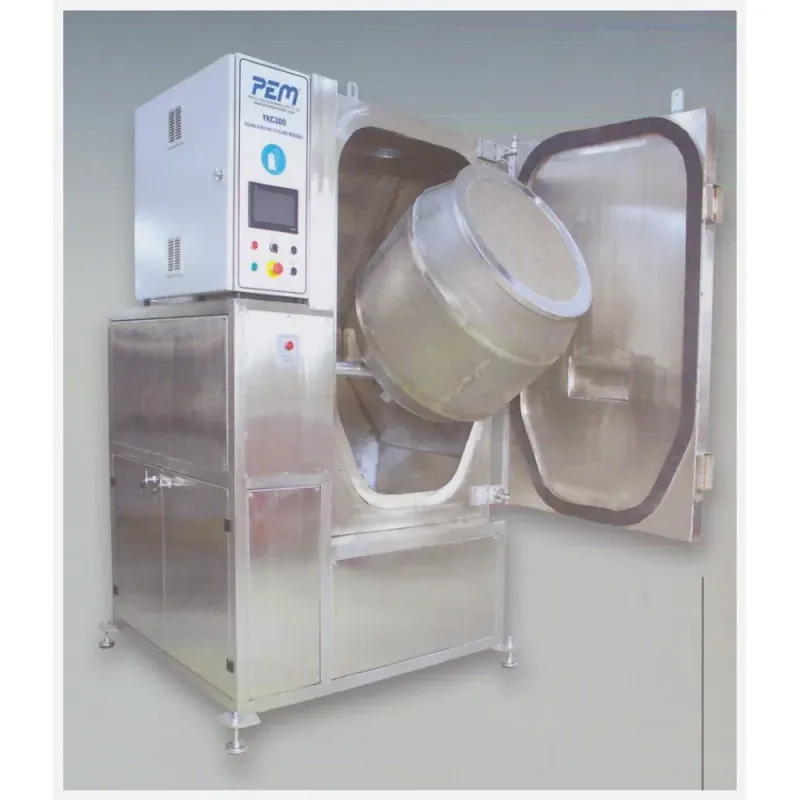
In the CDM series of cryogenic deflashing machines built by Prestij Endüstri, the process runs as follows:
- Parts are loaded into a perforated drum, and the drum is placed in the insulated process chamber.
- Liquid nitrogen is sprayed into the chamber; the temperature is lowered to the value set in the recipe and held there.
- As the drum rotates the parts tumble against each other, while a high-speed turbine throws plastic media onto them.
- The media impact breaks away the embrittled flash; the body of the part keeps its elasticity and is left unharmed.
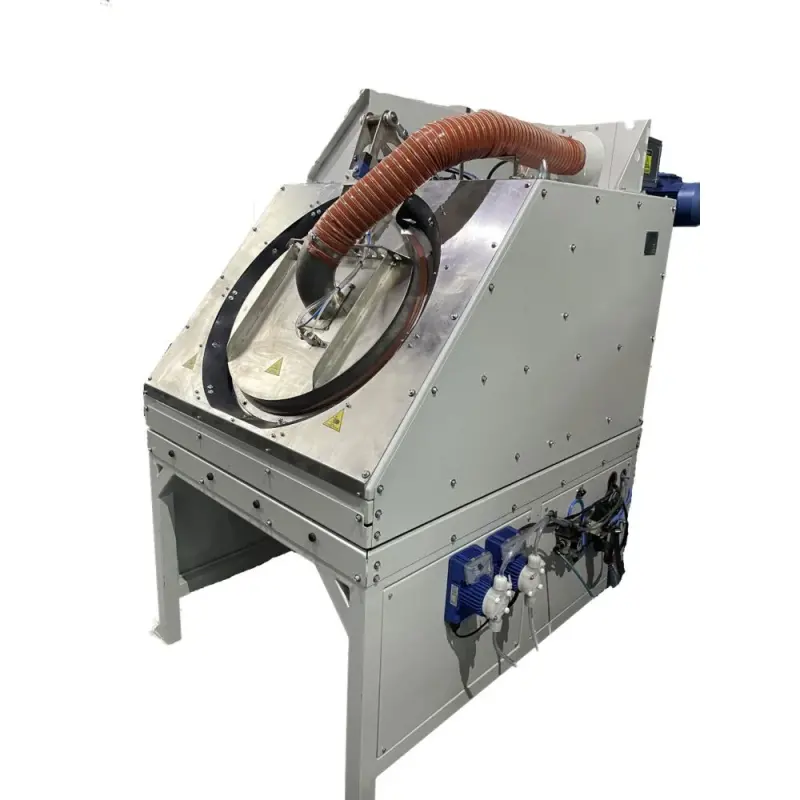
- At the end of the cycle the mixture passes through a screen system that separates parts, media and flash dust.
Drum, turbine and media: three elements in balance
The quality of the result depends on tuning these three elements together. Drum speed governs how the parts move inside the chamber, turbine speed sets the impact energy of the media, and media size determines how fine a flash can be removed. Delicate o-rings call for low turbine speed and small media, while thick-walled seals can take more energy. The recipe is developed through trial cycles according to part geometry and compound hardness, then stored on the control panel.
The multi-deck screen
The mixture that leaves the chamber contains three fractions: cleaned parts, media to be reused, and fine flash dust. CDM machines use a two- or three-deck screen to separate them in a single pass. The top deck retains the parts, the middle deck recovers the media, and the dust that falls through to the bottom is collected as waste. Choosing the mesh size to suit the part prevents small parts from mixing with the media.
Which parts are suitable?
The method works for any flash that is noticeably thinner than the body of the part. The part groups most often encountered in practice are:
- O-rings and sealing gaskets: Flash on the parting line directly affects the sealing surface, making this the most critical application.
- Oil seals and bellows: Even on parts with metal inserts, the elastomer section can be cleaned safely.
- Silicone parts: Silicone mouldings for food, medical and kitchen products are the hardest group to trim with a blade; the cryogenic method offers a clear advantage here.
- Technical rubber parts: Vibration mounts, bushings, bumpers and small hose connectors.
On the other hand, parts with very thick flash or with thin fins that belong to the design require a carefully developed recipe; otherwise the intended thin sections may break as well.
Reducing nitrogen consumption
The main operating cost of cryogenic deflashing is liquid nitrogen. Consumption is influenced by chamber insulation, the starting temperature of the parts, the fill ratio of the drum and the cycle time. Prestij Endüstri recommends the DKCM20 pre-cooling unit at this point: parts are cooled in stages in this unit before entering the main process chamber. Because the main machine then has a smaller temperature gap to close, the amount of nitrogen sprayed per cycle drops noticeably and the cycle itself becomes shorter. Other simple measures that reduce consumption include:
- Loading the drum to the fill ratio specified in the recipe; half loads raise the nitrogen cost per part.
- Processing parts after they have cooled to ambient temperature rather than straight from the mould.
- Not leaving the chamber lid open between cycles.
- Choosing the right turbine and media combination so that cycles are not needlessly long.
Conclusion
Cryogenic deflashing has replaced mechanical methods for rubber and silicone parts thanks to repeatable quality, low labour input and the absence of part damage. With the right recipe and pre-cooling, nitrogen consumption can be kept under control. Drawing on experience in industrial automation since 1989 and in machinery for the rubber industry since 2010, Prestij Endüstri designs and manufactures the CDM series locally and provides recipe development and service support after installation.